

The Five Best UK Spa Towns for a Weekend Getaway
Posted on 2026/05/06 , tagged as Ian Bradley, The Last Enchanted Places, Travel, UK Travel, history
Share this
We’re well and truly into May! With another long weekend just around the corner and warmer weather hitting the UK, it’s the ideal time to take a self care weekend in a gorgeous spa town. Read on for five UK spa towns perfect for a getaway. Our picks are taken from The Last Enchanted Places: Spa Towns of Europe by Ian Bradley which was published on the 2nd of April 2026 by Icon Books.
In this stunning guide, the author describes the experience of taking the waters and relishing the atmosphere at twenty spas in Britain and on the Continent, seven of which have recently been given UNESCO World Heritage status as ‘The Great Spa Towns of Europe’. The book blends personal reminiscences with a historical overview, amusing anecdotes, factual information and useful tips for visitors. The result is a fascinating, entertaining and informative survey of these last enchanted places which are being increasingly visited by tourists for their cultural and historic connections as much as their therapeutic benefits.
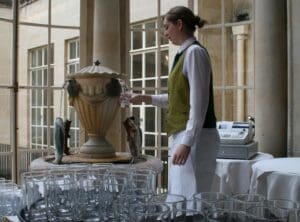
Serving water in the Pump Room, Bath.
1. Bath, Somerset
Bath is Britain’s best-known spa town and probably its most-loved. It’s home to the hottest natural thermal mineral waters in the UK, emerging at a temperature of 46°C. Its springs have been venerated and thought to hold magical, therapeutic powers since prehistoric times. The Romans built the city’s iconic baths which fed directly from the hot springs as a place of worship and recreation. Bath remained England’s most fashionable spa, attracting visitors for centuries as a place of culture and society and remains popular with tourists today. If you’re enjoying a weekend in Bath, try taking brunch or afternoon tea in the Pump Room after visiting the Roman Baths where the resident trio plays spa music from 2pm to 4pm daily. They iconic Bath bun is served in the morning, or you can take a trip to Sally Lunn’s for them all day. You should also make sure to visit the Abbey, and tale a walking trail around the city, such as those available at the Bath World Heritage Centre in York Street and finish off your day with a twilight package at the Thermae Bath Spa.
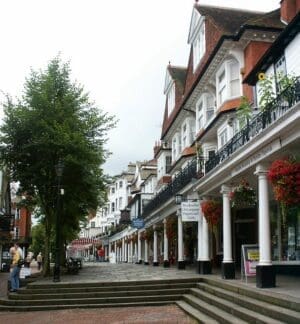
© Paul Collins / The Pantiles, Royal Tunbridge Wells / CC BY-SA 2.0
2. Tunbridge Wells, Kent
While Bath is the spot that springs to mind, for much of the seventeenth century, Tunbridge Wells was the most popular pick for a UK spa town. The curative properties of the water were supposedly first discovered in 1606 by Lord North to ease a weekend of heavy drinking. His enthusiasm for the spot led to a flood of high-society visitors looking to reap the benefits of the iron-rich waters. While its annual visitors were a fraction of Bath, Tunbridge Wells became home to a number of facilities. Assembly Rooms were built in 1738, a Bath House with cold baths in 1780 and heated baths in 1802. Alongside this, it claimed to boast more intellectual amusements such as its Circulating Library, Bookshop and Coffee House. If you’re taking a trip to Tunbridge Wells, stop in at the town’s museum and art gallery and Hall’s second-hand bookshop. There are plenty of hotels and restaurants to enjoy including several stunning afternoon tea spots along mount Ephraim. But above all, don’t miss the the walk to Dunorlan Park and the chalybeate spring (don’t drink from it though!).
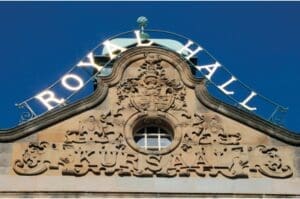
Original Kursaal name on top of the Royal Hall, Harrogate.
3. Harrogate, Yorkshire
One of the longest-established spa towns in England, it is known for its pungent odour that comes from the highest concentration of sulphur in Britain. Many of Harrogate’s natural mineral springs can be found in the Valley Gardens, a park in the Western side of the town centre. The nineteenth century saw the height of Harrogate’s popularity as thousands came to drink and bath every year. This peak is still reflected in the town’s architecture and you can learn of its vibrant and fashionable history from one of the many plaques across town. While the spa remained popular up to and through the 1930s, the Second World War saw its decline. While many of the original buildings are used for different purposes, you can book a two-hour session in The Turkish baths which are found in a small section of the old baths building. Apart from booking one of these sessions, if you find yourself in Harrogate, make sure you visit the Pump Room Museum, take a stroll through the Valley Gardens to the Royal Horticultural Society gardens and finish your day by sampling the Yorkshire rarebit or a cream tea (or both) at Betty’s.
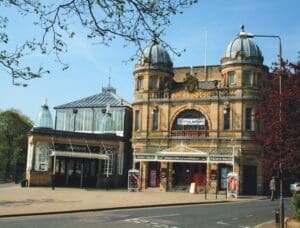
Opera House, Buxton.
4. Buxton, Derbyshire
Found on the edge of the Derbyshire Peak District, 1,000-feet above sea level, Buxton has been dubbed the “mountain spa” of England. Apart from Bath, it’s the only place in the British Isles where you can find natural thermal mineral water. At a temperature of 27.5°C the slightly radioactive water are cooler than Bath and have large quantities of nitrogen and carbon dioxide gas. While the use of the water dates back as far as the Iron Age, it was the Romans who popularised the spot. Buxton home to a increasingly wide array of attractions by the early 1800s, becoming one of Britain’s first holiday resorts but the reducing popularity of spa medicine meant visitor numbers decreased in the later half of the 20th century. It has recently been revived with the re-opening of the Edwardian Opera House and the annual International Buxton Festival, becoming one of Britain’s leading music festivals and the venue hosting a range of talent through the rest of the year. Since then, several other exciting buildings have been resurrected including the Buxton Crescent Hotel which houses the most extensive thermal mineral water treatments and facilities in Britain. Apart from a swim or treatment in the Buxton Crescent Hotel, when visiting, make sure to have a drink of the water in the Pump Room or St Ann’s Well, wander through the Winter Gardens from the Opera House and check out the Crescent Experience.
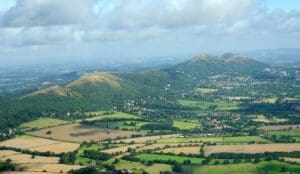
© “Aerial 2 – Malverns” by David Martyn Hunt, CC BY 2.0
5. Malvern, Worcestershire
Leafy and well-worth arriving at by train, Malvern is home to incredibly pure water from one of the most ancient rock formations in England. The town became popular as a health resort in the mid-nineteenth century which included several unorthodox treatments, attracting high society Victorians including Alfred Tennyson. Over the years, the town grew with the Assembly Rooms and Pleasure Gardens (now known as Priory Park) opening and the number of hotels and guest houses increasing dramatically. While spa medicine reduced in popularity, Malvern remained a holiday destination and it retains much of its Victorian architecture to this day. If you find yourself in Malvern, make sure to browse Rossiter Books who have hosted Ian Bradley himself for an event, take the Malvern Heritage Trail, and fill up a few bottles at the Malvhina Spout.
Taken from The Last Enchanted Places: Spa Towns of Europe by Ian Bradley. Out now, £18.99.
