

6 Historic Locations From Mad Tom’s Rising by Ian Breckon You Can Still Visit Today!
Posted on 2026/02/04 , tagged as
Share this
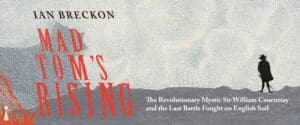
Today is the publication of Mad Tom’s Rising: The Revolutionary Mystic Sir William Courtenay and the Last Battle Fought on English Soil by Ian Breckon. In the villages and fields of Kent at the dawn of the Victorian era, not everything is as it seems. Poverty and the workhouse cast long shadows across rural England, and a traditional way of life is coming to an end. The discontented find an unlikely champion in John Nicholls Tom who calls himself ‘Sir William Courtenay’. To the local magistrates and gentry he is a madman, a charlatan, or a dangerous radical. But for the labouring people he is the New Messiah, come to lead them in a revolt against the forces of oppression, and to herald the end of the world.
In May 1838 Tom’s crusade ignites into bloody violence and the confrontation that follows will shock the country. This winter discover how a malt-dealer from Truro reinvented himself as a skilled fraudster, who would permanently reshape local history and ignite the last battle fought on English soil.
Read on for Ian Breckon’s top choices of the historic places within Mad Tom’s Rising that you can still visit today!
1. Canterbury
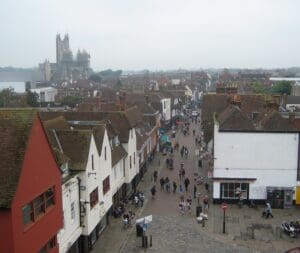
Canterbury was the site of John Nicholls Tom’s earliest appearances in his guise as Sir William Courtenay. In 1832 he became an instant celebrity in the city, later standing for parliament, getting arrested for swindling, provoking a riot and challenging his enemies to mortal combat. Canterbury was heavily bombed in the Second World War, but enough of the old city survives to give a picture of how it would have been in the days that ‘Sir William’ brought the place to rowdy and bombastic life. The medieval Westgate still stands, adjoining the prison where he was briefly held captive, and at the other end of the town centre the remaining wing of St Augustine’s Abbey holds another of Tom’s lodging places. The old streets around the cathedral retain a lot of their ancient charm, while the cathedral itself has a plaque to Lieutenant Henry Boswell Bennett, the second of Tom’s victims, who ‘fell in the strict and manly discharge of his duties, in Bosenden Wood…’
2. Mount Ephraim
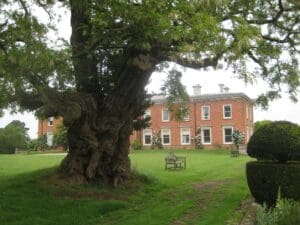
Mount Ephraim has long been the home of the Dawes family, who still own the mansion to this day. In the 1830s it was leased to Charles Handley, vicar of nearby Hernhill and one of the leading local adversaries of the impostor and revolutionary Sir William Courtenay. The house was largely rebuilt later in the Nineteenth Century, but the surrounding gardens and orchards still give a good impression of the setting of the older structure. The house also holds a large collection of Sir William Courtenay memorabilia, amassed towards the end of the Nineteenth Century and featuring everything from original pamphlets, documents and paintings to items supposedly owned by the impostor messiah himself, including his rampant lion flag. While much of it is locked away in storage, a selection is on view in the public rooms. Mount Ephraim today is the centre of a garden estate, and runs a bed and breakfast establishment; I can recommend both. The breakfasts are amazing, and the coffee particularly fine.
3. Bossenden Wood
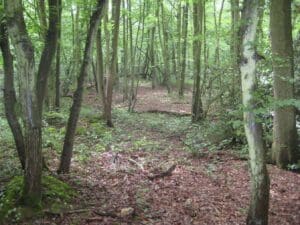
Bossenden Wood was the scene of the fateful final clash between John Tom and the forces of the government. Once it was much larger, a part of the huge and ancient Forest of the Blean that covered the high ground between Canterbury and Faversham. The western portion has subsequently been cleared, but the eastern half, and the wider woodland spreading away towards Canterbury, remains. A path leads northward into the wood from the old A2 road, east of the village of Dunkirk, and the site of the battle lies just to the left of it as it skirts the stream along the edge of the trees. An engraved stone slab, installed only recently, marks the site itself, although finding it can be difficult at the best of times. Bossenden Farm, John Tom’s final base of operations, is a private building at the end of a long lane. The Red Lion pub, where Tom’s body and those of some of his supporters were exhibited after the battle, still stands on the road nearby and looks much the same as it did in 1838, but has been out of operation for some years. With any luck, it may reopen one day.
4. Hernhill
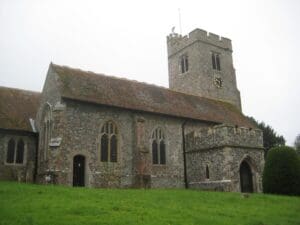
Hernhill is the little village on the hilltop across the vale from Mount Ephraim, and in the 1830s was the centre of the Reverend Charles Handley’s parish; many of Sir William’s followers had cottages in the nearby countryside. Handley’s church of St Michael’s stands beside the village green, with the Red Lion pub opposite. The churchyard holds the unmarked graves of John Nicholls Tom and six of the men killed at his side in 1838 – a memorial placard lists seven of them, but in reality one was buried at nearby Boughton instead. A new monument to the men is set to be unveiled in the churchyard in March 2026, and should provide a more solid record of their last resting place.
5. Boughton under Blean
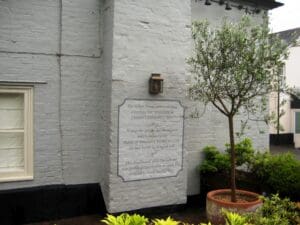
Boughton under Blean is an old village lying to the south of Hernhill. Once its core lay along the main London to Dover highway; the village has been bypassed now, leaving the street of old houses looking much the same as it did in 1838, when Sir William Courtenay and his band marched this way behind their lion flag. At the western end of the village is the White Horse pub: as a sign on the wall states, this was the scene of the initial inquests on the men slain in the uprising. Many of John Tom’s captured supporters were held overnight in a back room of the building, while the bodies of several of the slain were placed in the adjoining stable.
6. Truro
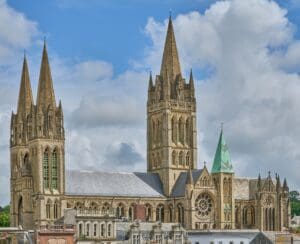
© Jake Pease Photography [public domain]
Truro was the home of John Nicholls Tom for most of the first thirty years of his life; he was manager of Mt Turner’s wine and spirit merchants in Pydar Street, and ran the adjacent malting operation too. The church of St Mary’s, where Tom married Catherine Fulpitt in 1828, was demolished and rebuilt later in the Nineteenth Century as Truro Cathedral. Tom was born in the village of St Columb Major, north of Truro near Newquay; he was baptised in St Columba’s church, which still stands to this day.
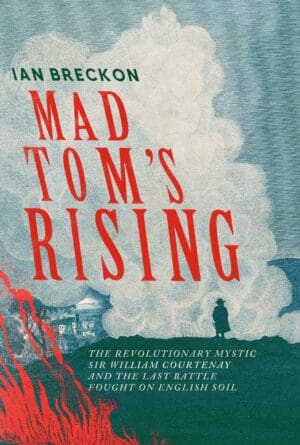
Mad Tom’s Rising: The Revolutionary Mystic Sir William Courtenay and the Last Battle Fought on English Soil by Ian Breckon is out now!

![public domain]](https://en.wikipedia.org/wiki/Truro#/media/File:Truro_Cathedral_city_view_crop.jpg)