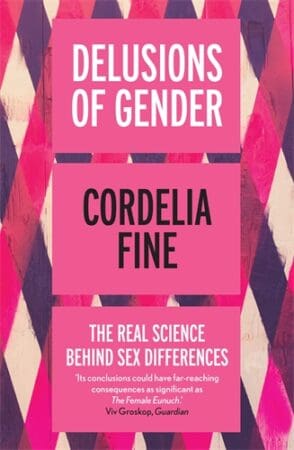
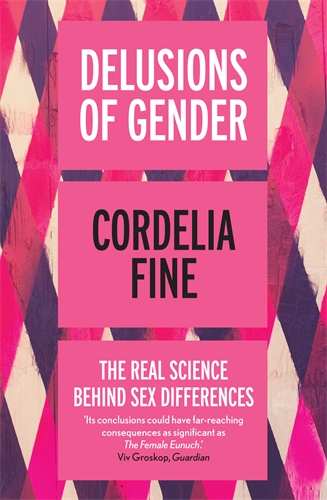
Delusions of Gender (eBook)
The Real Science Behind Sex Differences
Cordelia Fine
THE BRILLIANT AND HUGELY INFLUENTIAL BOOK BY THE WINNER OF THE 2017 ROYAL SOCIETY INSIGHT INVESTMENT SCIENCE BOOKS PRIZE
‘Fun, droll yet deeply serious.’
New Scientist
‘A brilliant feminist critic of the
neurosciences … Read her, enjoy and learn.’
Hilary Rose, THES
‘A witty and meticulously researched
exposé of the sloppy studies that pass for scientific
evidence in so many of today’s bestselling books
on sex differences.’
Carol Tavris, TLS
Gender inequalities are increasingly defended by citing hard-wired differences between the male and
female brain. That’s why, we’re told, there are so few
women in science, so few men in the laundry room –
different brains are just suited to different things.
With sparkling wit and humour, Cordelia Fine attacks
this ‘neurosexism’, revealing the mind’s remarkable
plasticity, the substantial influence of culture on identity,
and the malleability of what we consider to be
‘hardwired’ difference.
This modern classic shows
the surprising extent to which boys and girls, men and
women are made – not born.
Cordelia Fine is a Professor of the History and Philosophy of Science at the University of Melbourne. She is the author of much-acclaimed A Mind of Its Own (Icon, 2006) and Testosterone Rex (Icon, 2017).
We are all in [Fine's] debt. She has the expertise to check the research references cited by academic as well as popular books on the subject, and she has the clarity and wit to impart her findings to the lay reader. She exposes shockingly lightweight research that is taken seriously and nuanced research that is misreported.Guardian
The hard data is illuminating, and engaging, but Fine manages a light touch throughout. This is a truly startling book.Independent on Sunday
Two books came out this year (2010) which, in the long-term, could change how we view gender for ever. … Cordelia Fine's 'Delusions of Gender: The Real Science Behind Sex Differences' (Icon Books) finally debunked the myth that men and women's minds are significantly different …. Both books were favourably reviewed and hotly discussed. Over time their conclusions could have far-reaching consequences as significant as 'The Female Eunuch.'Viv Groskop, Guardian
A fascinating subject. A bracing argument.Evening Standard
'Delusions of Gender' … carefully and with great precision demolishes the nonsense that pervades the popular and technical literature pretending to be scientific fact, exposing it as truthiness which is nowhere close to truth. … When I first heard about this book it was clear, even before reading it, that this is the book we've been waiting for. Now, having read it, I can assure you that it is even better than I thought it could be. … Buy it. Get your friends, your colleagues, your family members to buy it, or buy it for them. Get it to your local school board. Make it required reading, not only in gender studies, but in freshman sociology, biology, education and business courses. Get it on the New York Times bestseller list. … Our culture is saturated with sloppy self-reinforcing non-thinking about gender. It will take a monumental effort to get it off those tracks. 'Delusions of Gender' is an excellent place to start.Professor Judy Roitman, Association for Women in Mathematics Newsletter
Fine is fun, droll yet deeply serious. Setting a cracking pace, Delusions tackles the power of implicit association (those unconscious associations we make about men and women) and of negative stereotyping, plus the empathising/systematising theory proposed by psychologist Simon Baron-Cohen, and the messy world of brain scans and genetic research. Her conclusion: we are in thrall to "neurosexism".New Scientist
The result of Fine's irritation is a witty and meticulously researched exposé of the sloppy studies that pass for scientific evidence in so many of today's bestselling books on sex differences… Can we stop talking about brains now? Those who can't, and anyone else who would like to know what today's best science reveals about gender differences – and similarities – could not do better than read this book.Carol Tavris, TLS
['Brain Storm' and 'Delusions of Gender' are] well-informed, well-argued and (for science books, perhaps unusually) well-written interventions in … one of the most important debates in current sexual politics.Trouble and Strife Journal
If you believe that the tide of blue and pink that greets children whenever they walk into a toy or children's clothes shop is just about colours … think again.Working Mums
This is a book with such a large scope that it's near-impossible to overestimate its importance. Much like 'The Spirit Level' did for socio-economics, this book ropes together decades' worth of studies on gender differences and casts a cool, calm eye (and an arched brow) over them all… This book will cast a light on gender assumptions you didn't know you had, and it's hilarious – with chapter titles such as 'We Think, Therefore You Are' and 'Sex and Premature Speculation,' Dr Fine is a brilliant tour guide – making light, fun and engaging work of the research. By debunking the rubbish, this book opens up possibilities for a (slightly) clearer vision of the future. Not to be missed.Fat Quarter
In 'Delusions of Gender' Cordelia Fine does a magnificent job debunking the so-called science, and especially the brain science, of gender. If you thought there were some inescapable facts about women's minds – some hard wiring that explains poor science and maths performance, or the ability to remember to buy the milk and arrange the holidays – you can put these on the rubbish heap. Instead, Fine shows that there are almost no areas of performance that are not touched by cultural stereotypes. This scholarly book will make you itch to press the delete button on so much nonsense, while being pure fun to read.Emeritus Professor Uta Frith, Institute of Cognitive Neuroscience, University College London, Research Foundation Professor, University of Aarhus
'Cordelia Fine has a first-rate intellect and writing talent to burn. In her new book, Delusions of Gender, she takes aim at the idea that male brains and female brains are "wired differently", leading men and women to act in a manner consistent with decades-old gender stereotypes. Armed with penetrating insights, a rapier wit, and a slew of carefully researched facts, Fine lowers her visor, lifts her lance, and attacks this idea full-force. Whether her adversaries can rally their forces and mount a successful counter-attack remains to be seen. What's certain at this point, however, is that in Delusions of Gender Cordelia Fine has struck a terrific first blow against what she calls "neurosexism".Professor William Ickes, author of 'Everyday Mind Reading: Understanding What Other People Think and Feel.'
Fine turns the popular science book formula on its head.USA Today
The author, Cordelia Fine, who has a Ph.D. in cognitive neuroscience from University College London, is an acerbic critic, mincing no words when it comes to those she disagrees with. But her sharp tongue is tempered with humor and linguistic playfulness, as the title itself suggests…. It's too late to tell that to Dr. Sax, a proponent of single-sex education, who cited the Connellan study as evidence that 'girls are born prewired to be interested in faces while boys are prewired to be more interested in moving objects.' But it's not too late to read this book and see how complex and fascinating the whole issue is.New York Times
So both sexes should rejoice at Cordelia Fine's new book, Delusions of Gender, a vitriolic attack on the sexism masquerading as psychology that is enjoying a renaissance.Rosamund Irwin, London Evening Standard
Impeccably researched and bitingly funny.Rosamund Irwin, London Evening Standard
Fine's tone is witty but the citations are detailed and the bibliography extensive…This book is an entertaining weapon in that fight (for education and social justice) and will make a nice "thwok" sound bouncing off the heads of sexists.Sarah Ensor, Socialist review
Fine's conclusions provide a timely warning against taking too seriously the deluge of books and articles that would have us believe that men are biologically advantaged when it comes to mathematics, racing, driving or map reading – and that women are naturally more intuitive and nurturing, so better at childcare and multitasking.Claire Jones, Guardian
In Delusions of Gender the psychologist Cordelia Fine exposes the bad science, the ridiculous arguments and the persistent biases that blind us to the ways we ourselves enforce the gender stereotypes we think we are trying to overcome.Terri Apter, Guardian
Fine eviscerates both the neuroscientists who claim to have found the answers and the popularisers who take their findings and run with them.Katherine Bouton, Deputy Editor of New York Times Magazine.
Timely and provocative, her argument is also excellent at debunking oversimplified theories, for instance, that biology is destiny.Metro
A well-stocked armoury that includes extensive research, sharp whit and a probing intelligence, and which refuses to be satisfied with the delusional myth-making that often passes for popular science.Metro
Fine offers persuasive proof that many of the claims we commonly swallow about male and female brains are based on very bad science indeed. Her entire book … is worth a read, and perhaps should be taught in high school and college science classes. Maybe if young women were exposed to the truth about their brains, they'd no longer feel like they had to chuck their gender overboard in order to pursue their dreams.Anna North, Jezebel
With Delusions of Gender, we welcome a brilliant feminist critic of the neurosciences … In a book that sparkles with wit, which is easy to read but underpinned by substantial scholarship and a formidable 100-page bibliography, she attacks the ready generalisations on sexual differences made by neuroscientists and their media exegetes … every page of Fine's brilliant, spiky book reminds us that science is part of culture and that the struggle against sexism in the neurosciences and the struggle against sexism in society are intimately linked. Read her, enjoy and learn.Hilary Rose, THES
An excellent introduction to the scientific method … mind-opening … prepare to be a relative expert on the subject.British Neuroscience Association Bulletin
A pinnacle piece of feminist literature, which I thoroughly recommend and could quote all day.Fran Hall, Huffington Post
[a] brilliant debunking of "neuro-sexism" … a powerful case that who we are is much more closely attuned to the culture that surrounds us, than to the biology of our brains.Mslexia
For anyone interested in the brain, research methods, applied science, gender, parenting, the workplace, human nature or general sass, this book is an absolute must read.Cyndi Chen, Huffington Post
Popular science writing at its best … beautifully and accessibly written … It is a cracking good read, by turns witty, passionate and learned.National Childbirth Trust Journal