

Introducing Graphic Guide box set – Think for Yourself ()
Dan Cryan Dave Robinson Sharron Shatil
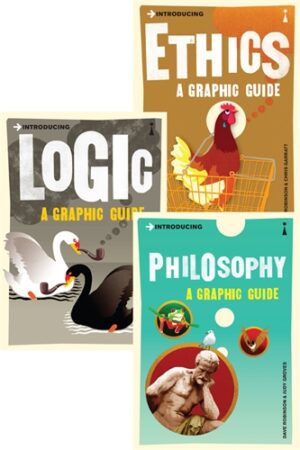
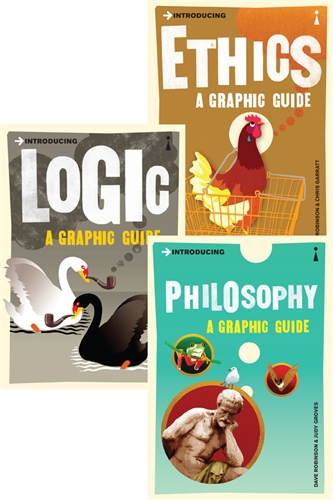
A set of three insightful, graphic novel-style Introducing Graphic Guides guaranteed to expand your mind – on Ethics, Logic and Philosophy.
A set of three insightful, graphic novel-style Introducing Graphic Guides guaranteed to expand your mind – on Ethics, Logic and Philosophy.
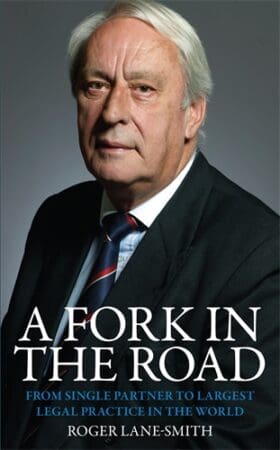

How did Roger Lane-Smith build up the world’s largest law firm within 30 years, starting from a tiny office in a Manchester side-street? This compelling autobiography will tell you. Told with candour and great humour, this is the story of one lawyer’s determined quest for the biggest and the best – and shows exactly how it was done.
Equally at home with Hollywood celebrities such as Aaron Spelling, David Soul and Joan Collins as with captains of industry and commerce, Roger Lane-Smith really has ‘seen it all’. The story of his life is about much more than the law – he has been close to some of the key moments of the last 30 years, from the legal shenanigans of the icons of popular culture to the deals he has made at the cutting edge of high finance.
Everyone with an interest in the law will find this book a treasure trove of information and gossip, and it will appeal equally to anyone keen to see how a successful business can be built through hard work and astute risk-taking.
Roger Lane-Smith was born in 1945 at Adlington Hall in Cheshire, England.
He qualified as a lawyer in 1969 and in 1977 started his own single-partner law firm in Manchester, intent on creating from scratch the world’s largest law firm. Thirty-three years later he achieved this ambition with the firm of DLA Piper, now the world’s largest with in excess of 4,500 fee-earners across 87 offices in 32 countries with revenues of £1.5bn.
Roger has been married for 45 years to Pamela and they live in Cheshire and in Provence. They have two adult children, Zoë and Jonathan, and a grandson, Logan. Roger’s passions outside the law include golf, shooting and fine wine.|
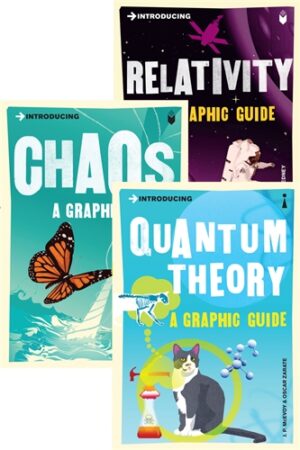
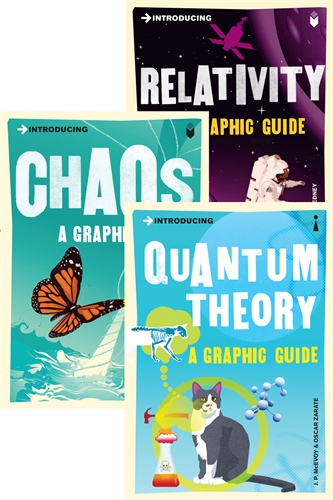
This set contains three brilliant Introducing Graphic Guides on mind-blowing ideas that have revolutionised our view of how the universe works – Quantum Theory, Relativity and Chaos.
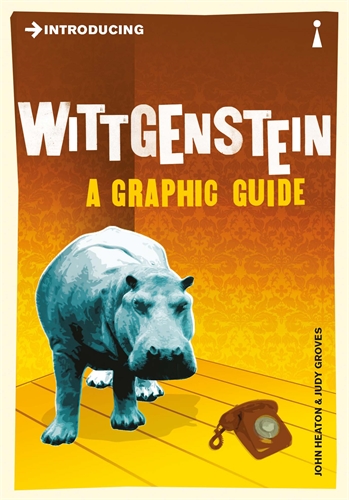
This is a superlative graphic guide described as 'warm, witty and wise' by Jonathan Ree to an enigmatic master of twentieth-century philosophy.
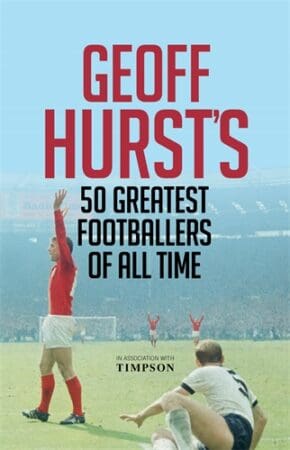
Half a century on from his Wembley hat-trick, England World Cup winner Sir Geoff Hurst risks controversy as he narrows down football’s finest to a select 50.
Which of his 1966 teammates have earned their place among the all-time greats? Would he have had Franz Beckenbauer in his XI ahead of Bobby Moore? What are his memories of playing against Pelé and Eusébio? And which England stars of later generations would Sir Geoff have loved to play alongside?
With first-hand tales of former teammates and rivals, along with tributes to those he’s admired from the terraces, Geoff Hurst’s Greats is essential reading for football fans of all ages.
Sir Geoff Hurst MBE is the only man to score a hat-trick in a World Cup final – for England in their historic 4–2 victory over West Germany at Wembley in 1966.
Having shown an early flair for cricket – playing a first-class match for Essex against Lancashire in 1962 – Hurst opted for a career in football, and with West Ham United he scored 248 goals in 499 first team appearances. There he won the FA Cup in 1964 and the European Cup Winners' Cup 1965. He was selected by Alf Ramsey to lead England’s attack between 1966 and 1972 – the longest run of any forward under Ramsey, scoring 24 goals in that time.
Shakespeare's absolute pre-eminence is simply unparalleled. His plays pack theatres and provide Hollywood with block-buster scripts; his works inspire mountains of scholarship and criticism every year. He has given us many of the very words we speak, and even some of the thoughts we think.
Nick Groom and Piero explore how Shakespeare became so famous and influential, and why he is still widely considered the greatest writer ever. They investigate how the Bard has been worshiped at different times and in different places, used and abused to cultural and political ends, and the roots of intense controversies which have surrounded his work.
Much more than a biography or a guide to his plays and sonnets, Introducing Shakespeare is a tour through the world of Will and concludes that even after centuries, Shakespeare remains the battlefield on which our very comprehension of humanity is being fought out.
Nick Groom is Senior Lecturer in Post-Mediaeval Literature at the University of Bristol, and has published widely on Shakespeare, literature and contemporary culture. He is a regular contributor to The Times Higher Education Supplement, and lives on Dartmoor and in London.
Piero is an illustrator and graphic designer, selected twice for the 'Best of British Illustration' in 1998 and 1999, exhibiting his work at the Royal College of Art. He currently works for a London-based Latin newspaper.
"Introducing Semiotics" outlines the development of sign study from its classical precursors to contemporary post-structuralism. Through Paul Cobley's incisive text and Litza Jansz's brilliant illustrations, it identifies the key semioticians and their work and explains the simple concepts behind difficult terms. For anybody who wishes to know why signs are crucial to human existence and how we can begin to study systems of signification, this book is the place to start.
Philosophy, art, literature, music, and politics were all transformed in the turbulent period between the French Revolution of 1789 and the Communist Manifesto of 1848.
This was the age of the 'Romantic revolution', when modern attitudes to political and artistic freedom were born.
When we think of Romanticism, flamboyant figures such as Byron or Shelley instantly spring to mind, but what about Napoleon or Hegel, Turner or Blake, Wagner or Marx?
How was it that Romanticism could give birth to passionate individualism and chauvinistic nationalism at the same time? How did it prefigure the totalitarian movements of the 20th century?
Duncan Heath and Judy Boreham answer these questions and provide a unique overview of the many interlocking strands of Romanticism, focusing on the leading figures in Britain, Germany, France, Italy, Russia and America.
Duncan Heath is Editorial Director of Icon Books.
Judy Boreham is an acclaimed graphic artist.
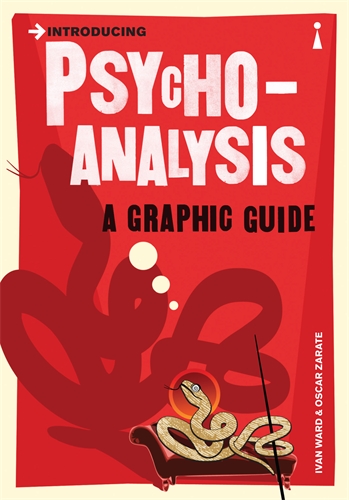
The ideas of psychoanalysis have permeated Western culture. It is the dominant paradigm through which we understand our emotional lives, and Freud still finds himself an iconic figure. Yet despite the constant stream of anti-Freud literature, little is known about contemporary psychoanalysis.
Introducing Psychoanalysis redresses the balance. It introduces psychoanalysis as a unified 'theory of the unconscious' with a variety of different theoretical and therapeutic approaches, explains some of the strange ways in which psychoanalysts think about the mind, and is one of the few books to connect psychoanalysis to everyday life and common understanding of the world.
How do psychoanalysts conceptualize the mind?
Why was Freud so interested in sex?
Is psychoanalysis a science?
How does analysis work?
In answering these questions, this book offers new insights into the nature of psychoanalytic theory and original ways of describing therapeutic practice. The theory comes alive through Oscar Zarate's insightful and daring illustrations, which enlighten the text. In demystifying and explaining psychoanalysis, this book will be of interest to students, teachers and the general public.
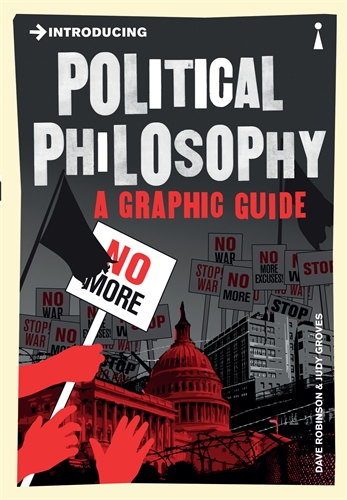
Essential illustrated guide to key ideas of political thought. Philosophers have always asked fundamental and disturbing questions about politics. Plato and Aristotle debated the merits of democracy. The origins of society, the state and government authority were issues addressed by Hobbes, Rousseau, Hegel, Marx and many other philosophers. Introducing Political Philosophy explains the central concepts of this intriguing branch of philosophy and presents the major political theorists from Plato to Foucault. How did governments get started? Why should they be obeyed? Could we live without them? How much power should they have? Is freedom a right? Which is the best form of government? In the wake of consumerism and postmodernism, our need for a better grasp of political ideas is greater than ever. Dave Robinson's account of this complex subject is always clear, informative and accompanied by the entertainingly inventive illustrations of Judy Groves.
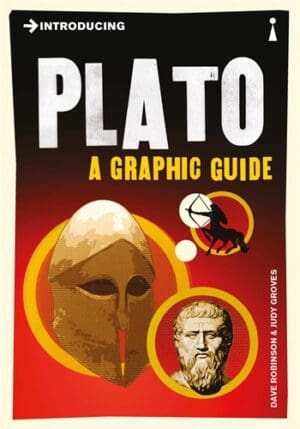
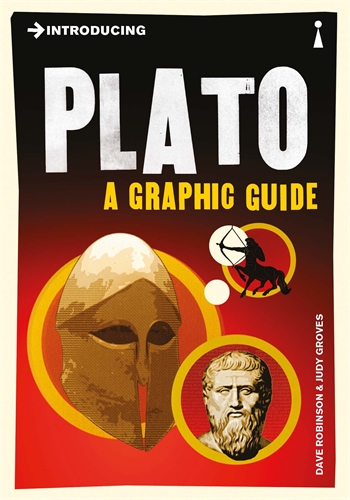
"Introducing Plato" begins by explaining how philosophers like Socrates and Pythagoras influenced Plato's thought. It provides a clear account of Plato's puzzling theory of knowledge, and explains how this theory then directed his provocative views on politics, ethics and individual liberty. It offers detailed critical commentaries on all of the key doctrines of Platonism, especially the very odd theory of Forms, and concludes by revealing how Plato's philosophy stimulated the work of important modern thinkers such as Karl Popper, Martha Nussbaum, and Jacques Derrida.
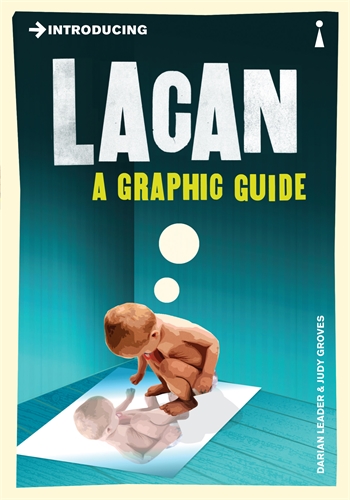
Jacques Lacan is regarded as a major psychoanalytical theorist alongside Freud and Jung, although recognition has been delayed by fierce arguments over his ideas. This title guides the reader through his innovations, including his work on paranoia, his addition of structural linguistics to Freudianism and his ideas on the infant 'mirror phase'.
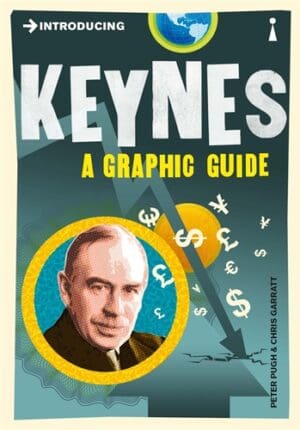
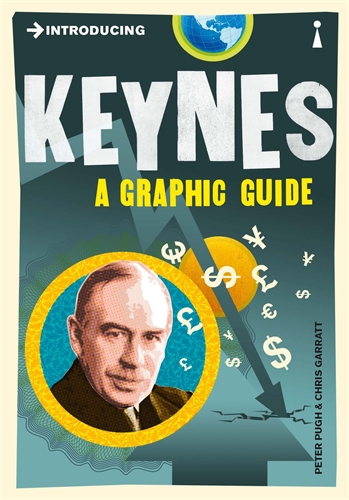
Forming his economic theories in the wake of the Great Depression, John Maynard Keynes argued that a healthy economy depended on the total spending of consumers, business investors and, most importantly, governments too. This graphic guide presents an introduction to one of the most influential economists of the 20th century.
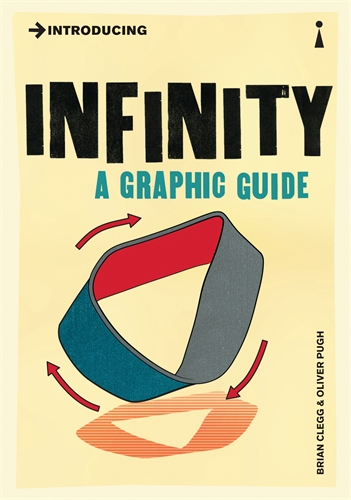
Infinity is a profoundly counter-intuitive and brain-twisting subject that has inspired some great thinkers – and provoked and shocked others.
The ancient Greeks were so horrified by the implications of an endless number that they drowned the man who gave away the secret. And a German mathematician was driven mad by the repercussions of his discovery of transfinite numbers.
Brian Clegg and Oliver Pugh’s brilliant graphic tour of infinity features a cast of characters ranging from Archimedes and Pythagoras to al-Khwarizmi, Fibonacci, Galileo, Newton, Leibniz, Cantor, Venn, Gödel and Mandelbrot, and shows how infinity has challenged the finest minds of science and mathematics. Prepare to enter a world of paradox.
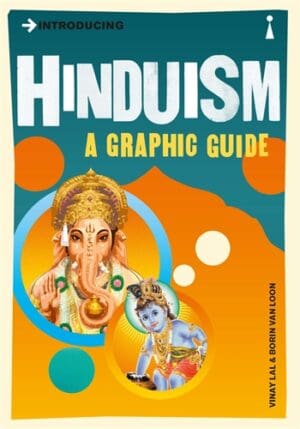
Why do Hindus revere the cow?
Must Hindus be vegetarian?
Hinduism is the world’s oldest religion, yet the word ‘Hindu’ was never used before the 18th century by Hindus to describe themselves. it is defined as polytheistic, but Gandhi declared that a Hindu needn’t believe in any god. it is a religion as much of myth as of history – it has no founder, no single authoritative book, even few central doctrines.
Introducing Hinduism offers a guide to the key philosophical, literary, mythological and cultural traditions of the extraordinarily diverse faith. It untangles the complexities of Hinduism's gods and goddesses, its caste system and its views on sex, everyday life and asceticism.
Vinay Lal and Borin Van Loon’s hugely enjoyable tour through Hinduism also explores its links with and differences from Buddhism, Jainism and other religions, the resurgence of Hindu extremism, the phenomenon of Bollywood and the overseas Hindu diaspora.
Vinay Lal teaches at UCLA. He writes widely on Indian history, contemporary politics, Bollywood and the Indian diaspora. Recent books include The History of History: Politics and Scholarship in Modern India (Oxford University Press, 2003).
Borin Van Loon has worked on numerous 'Introducing' titles. He is a freelance illustrator, surrealist painter and collagist who produces the comic strip 'The Severed Head' for The Chap magazine
Brilliant illustrated guide to the best-known and most controversial continental philosopher of the latter 20th century. Jacques Derrida is the most famous philosopher of the late 20th century. Yet Derrida has undermined the rules of philosophy, rejected its methods, broken its procedures and contaminated it with literary styles of writing. Derrida's philosophy is a puzzling array of oblique, deviant and yet rigorous tactics for destabilizing texts, meanings and identities. 'Deconstruction', as these strategies have been called, is reviled and celebrated in equal measure. Introducing Derrida introduces and explains his work, taking us on an intellectual adventure that disturbs some of our most comfortable habits of thought.
Anthropology originated as the study of 'primitive' cultures. But the notion of 'primitive' exposes presumptions of 'civilized' superiority and the right of the West to speak for 'less evolved' others. With the fall of Empire, anthropology became suspect and was torn by dissension from within. Did anthropology serve as a 'handmaiden to colonialism'? Is it a 'science' created by racism to prove racism? Can it aid communication between cultures, or does it reinforce our differences? "Introducing Anthropology" is a fascinating account of an uncertain human science seeking to transcend its unsavoury history. It traces the evolution of anthropology from its genesis in Ancient Greece to its varied forms in contemporary times. Anthropology's key concepts and methods are explained, and we are presented with such big-name anthropologists as Franz Boas, Bronislaw Malinowski, E.E. Evans-Pritchard, Margaret Mead and Claude Levi-Strauss. The new varieties of self-critical and postmodern anthropologies are examined, and the leading question – of the impact of anthropology on non-Western cultures – is given centre-stage. "Introducing Anthropology" is lucid in its arguments, its good humour supported by apt and witty illustrations. This book offers a highly accessible invitation into anthropology.
The works of French philosopher Alain Badiou range from novels, poems, 'romanopéras' and popular political treatises to elaborate philosophical arguments engaging with mathematical theory.
Badiou suggests that 'philosophy is always a biography of the philosopher', and throughout all of his writing there is a staunch commitment to emancipatory politics and a radical yet faithful subjectivity. His famous, or infamous, philosophy of emancipation is firmly grounded in his fidelity to the universal idea of a collective life.
Introducing Alain Badiou is an elegantly written and crisply illustrated guide to an essential contemporary thinker.
Michael Kelly is a historian, philosopher and Ph.D. Candidate at the University of Leeds. His research intersects contemporary thought with rigorous, historical research into early medieval existences, and he is very much engaged in the Philosophy of History and the use of the concept of History today. He is a General Editor of both the International Journal for Badiou Studies & Networks and Neighbours, coorganizer of the Philosophies of History and Lacan Read(s) Across the Disciplines seminar series at the University of Leeds.
Piero is an illustrator, artist and graphic designer whose work has twice been included in the Royal College of Art in London. He has illustrated many Introducing titles.
What is beauty, and what is truth? These are some of the questions which aesthetics tries to answer. In our everyday life, we talk about the 'aesthetics' of an artwork or a piece of design. But aesthetics goes beyond the simple experience of art. It is also a branch of philosophy concerned with the whole nature of experience itself, explored through our perceptions, feelings and emotions.
Barcelona has long been regarded as a home of beautiful football. In July 2014, already boasting Lionel Messi and Neymar, Barça added Luis Suárez to complete a forward line that was undeniably special, even by their own high standards.
They had taken greatly differing paths from South America to the starting line-up at the Nou Camp. Messi joined Barcelona aged just thirteen, Neymar served a spectacular apprenticeship in Brazil and Suárez enjoyed spells with Ajax and Liverpool – three prestigious educations with an emphasis on attractive play.
Through exclusive testimonies from friends, families, managers and teammates, acclaimed football writer Luca Caioli documents their individual journeys and examines the phenomenal success of Barça’s ‘MSN’ years to date, including the 2015/16 league and cup double.
